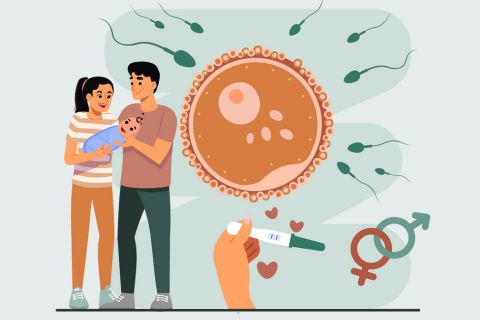
What It Takes for Natural Conception
Natural conception requires several male and female factors to work together at the right time.
On the female side, a woman should ideally release an egg regularly through ovulation. The fallopian tubes should be open so that the egg and sperm can meet. The uterus should have a healthy cavity and lining so that an embryo can implant. Hormonal balance, ovarian reserve, egg quality, and reproductive tract health all play important roles.
On the male side, the testes should produce sperm in adequate numbers, with good movement and structure. Sperm should be able to travel through the reproductive tract and be ejaculated into the vagina. The sperm must then move through the cervix and uterus to reach the fallopian tube, where fertilization usually occurs.
Timing also matters. Intercourse during the fertile window, especially in the few days before ovulation and on the day of ovulation, gives the best chance of pregnancy.
What Are the Chances of Natural Conception?
In healthy couples, natural conception is common but not guaranteed every month. Each menstrual cycle gives only a limited chance of pregnancy, even when everything is normal. Over time, the chances add up. NICE guidance states that over 80% of couples in the general population conceive within 1 year if the woman is under 40, contraception is not used, and intercourse is regular; among those who do not conceive in the first year, about half conceive in the second year.
Infertility is commonly defined as failure to achieve pregnancy after 12 months or more of regular unprotected intercourse. The WHO describes infertility as a disease of the male or female reproductive system, and it may be due to female factors, male factors, combined factors, or unexplained causes.
Evaluation should usually begin after 12 months of trying if the woman is under 35, and after 6 months if she is 35 or older. Earlier evaluation is important when there are known problems such as irregular periods, endometriosis, previous pelvic infection, known low sperm count, previous surgery, or recurrent pregnancy loss. ASRM recommends that fertility evaluation should be systematic, timely, cost-effective, and initially focused on common causes such as ovulatory dysfunction.
When Do Infertility Treatments Become Critical?
Treatment becomes important when there is a clear medical reason that natural conception is unlikely, or when time is a major factor. Examples include blocked fallopian tubes, severe male factor infertility, significantly reduced ovarian reserve, advanced female age, absent ovulation, moderate to severe endometriosis, or long-standing unexplained infertility.
Treatment may also become critical after repeated unsuccessful attempts with simpler options. A diagnosis-first approach avoids both extremes: delaying treatment when advanced care is needed and rushing into IVF when simpler treatment may work.
Ovulation Induction with Timed Intercourse
Ovulation induction timed intercourse is often one of the simplest fertility treatments. It uses medicines to help the ovary develop and release an egg. The couple is then advised to have intercourse during the fertile window, often guided by ultrasound follicle monitoring.
This treatment may be considered in women who do not ovulate regularly, such as some women with PCOS, or in couples where timing of intercourse is difficult. It may also be used in selected cases of unexplained infertility when the woman is young, the tubes are open, and semen parameters are reasonable.
The purpose is to improve the chance of egg release and ensure that intercourse happens at the right time. It makes sense when the basic pathway for natural conception is still intact: sperm can reach the egg, the tubes are open, and the uterus is suitable for implantation.
This treatment is usually less invasive and less expensive than IUI or IVF. However, it requires careful monitoring because too many follicles can increase the risk of multiple pregnancy.
Intrauterine Insemination, or IUI
IUI is a treatment in which a processed semen sample is placed directly into the uterus around the time of ovulation. The sperm are washed and concentrated in the laboratory, then introduced through a thin catheter.
IUI may be considered when there is mild male factor infertility, unexplained infertility, ovulation problems requiring stimulation, difficulty with intercourse, or use of donor sperm. It may also be useful when the fallopian tubes are open and the woman’s ovarian reserve and age are favorable.
IUI does not fertilize the egg outside the body. Fertilization still happens naturally inside the fallopian tube. The aim is to place a better concentration of motile sperm closer to the egg at the right time.
IUI is usually not the best option when both fallopian tubes are blocked, sperm counts are very low, ovarian reserve is severely reduced, or the woman’s age makes time a major concern. In such cases, IVF or IVF with ICSI may be more appropriate.
IVF: In Vitro Fertilization
IVF is a fertility treatment in which eggs are collected from the ovaries and fertilized with sperm in the laboratory. The resulting embryo is then transferred into the uterus.
IVF may be considered when the fallopian tubes are blocked, when other treatments have failed, when there is moderate to severe endometriosis, when ovarian reserve or age makes faster treatment important, or when there is significant male factor infertility. It is also used in some cases of unexplained infertility after simpler treatments have not worked.
The IVF process usually includes ovarian stimulation, ultrasound and hormone monitoring, egg retrieval, fertilization in the laboratory, embryo development, and embryo transfer. Extra embryos may sometimes be frozen for future use.
IVF is powerful because it bypasses several barriers to natural conception. It does not require the egg and sperm to meet inside the tube. It also allows doctors to observe fertilization and embryo development. However, IVF does not guarantee pregnancy. Success depends on age, egg quality, sperm quality, embryo quality, uterine factors, and the underlying diagnosis.
ICSI: Intracytoplasmic Sperm Injection
ICSI is a specialized form of IVF. In conventional IVF, eggs and sperm are placed together in the laboratory and fertilization occurs when a sperm enters the egg. In ICSI, a single sperm is injected directly into the egg.
ICSI is most useful when there is significant male factor infertility, such as very low sperm count, poor sperm movement, abnormal sperm function, surgically retrieved sperm, or previous fertilization failure. It may also be considered in selected IVF cases based on clinical judgment.
ICSI helps overcome problems where sperm may not be able to fertilize the egg on its own. However, ICSI is not automatically required for every IVF cycle. In couples with normal semen parameters, the need for ICSI should be discussed carefully. The goal is to use advanced technology when it adds value, not simply because it is available.
Laparoscopy in Infertility Care
Laparoscopy is a minimally invasive surgical procedure in which a camera is inserted through a small incision, usually near the navel, to look inside the pelvis. It can help diagnose and treat conditions affecting the uterus, tubes, ovaries, and surrounding pelvic structures.
Laparoscopy may be considered when endometriosis is suspected, when there is pelvic pain, previous pelvic infection, suspected adhesions, ovarian cysts, or possible tubal disease. It may also be useful when imaging suggests a correctable pelvic problem.
The procedure can identify problems that may not be fully visible on routine ultrasound. In some cases, treatment can be done at the same sitting, such as removal of endometriotic deposits, release of adhesions, treatment of ovarian cysts, or assessment of tubal patency.
Laparoscopy is not required for every couple with infertility. It is most useful when the findings are likely to change the treatment plan. For some couples, especially when IVF is clearly indicated, proceeding directly to IVF may be more appropriate than surgery.
Hysteroscopy in Infertility Care
Hysteroscopy is a procedure used to look inside the uterine cavity. A thin camera is passed through the cervix into the uterus. It helps diagnose and treat problems inside the womb.
Hysteroscopy may be considered when ultrasound suggests polyps, fibroids inside the cavity, adhesions, uterine septum, or an abnormal cavity. It may also be considered in recurrent implantation failure, recurrent pregnancy loss, or before fertility treatment when a cavity problem is suspected.
The uterine cavity matters because implantation happens inside the uterus. Even when eggs, sperm, and embryos are good, a cavity abnormality may reduce the chance of pregnancy or increase the risk of miscarriage.
Hysteroscopy can sometimes treat the problem immediately. Polyps can be removed, adhesions can be released, and certain structural abnormalities can be corrected. Like laparoscopy, hysteroscopy should be used when there is a clear reason, not as a routine procedure for every couple.
Choosing the Right Treatment
The best fertility treatment is not necessarily the most advanced treatment. It is the treatment that fits the diagnosis.
For a young woman with irregular ovulation and normal semen parameters, ovulation induction with timed intercourse may be enough. For mild male factor infertility or unexplained infertility with open tubes, IUI may be reasonable. For blocked tubes, severe male factor infertility, advanced age, or repeated failed simpler treatments, IVF or ICSI may be needed.
A good fertility plan should answer five questions:
- Is ovulation happening regularly?
- Are the fallopian tubes open?
- Is the semen analysis normal or treatable?
- Is the uterus suitable for implantation?
- Is time a major factor because of age or ovarian reserve?
Once these questions are answered, treatment becomes more rational and less stressful. Couples can understand why a treatment is being recommended, what it can achieve, what its limitations are, and when to move to the next step.
Kalpa Clinic’s Approach
Kalpa Clinic believes fertility care should begin with clarity. Many couples arrive worried that IVF is their only option. In reality, some couples may benefit from simpler, evidence-based treatments such as ovulation induction, timed intercourse, IUI, treatment of male factor issues, or correction of uterine or pelvic problems.
At the same time, delaying IVF when it is clearly needed can reduce the chance of success, especially when age or ovarian reserve is a concern. The goal is not to avoid IVF at all costs. The goal is to recommend IVF only when it is the right treatment.
This diagnosis-first approach helps couples make informed decisions, avoid unnecessary procedures, and choose the most appropriate path toward conception.