
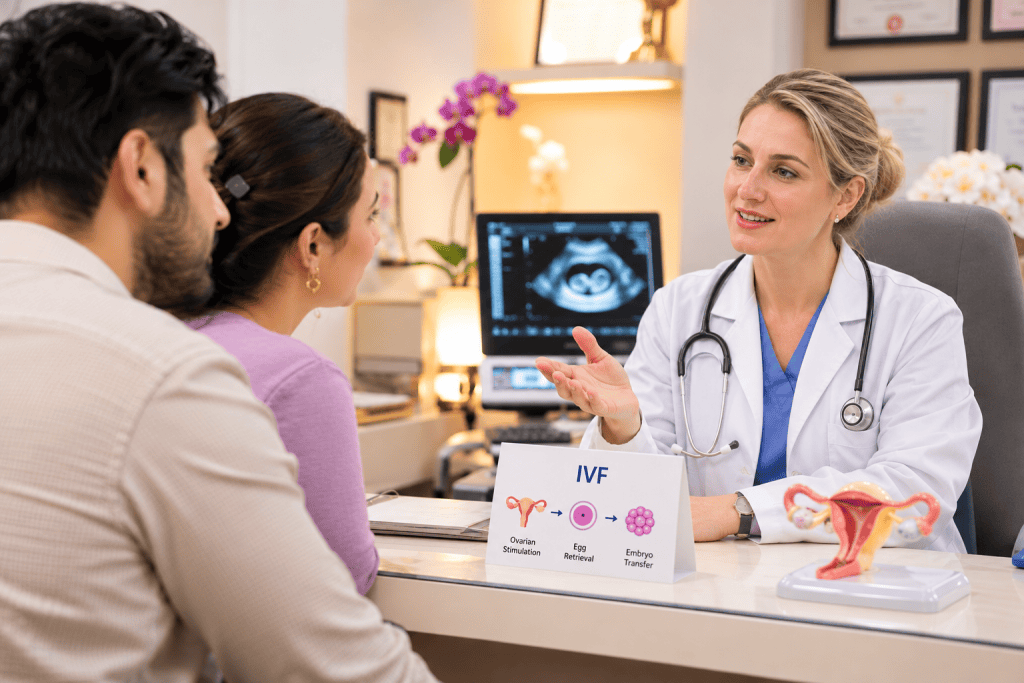
If you have been trying for a baby without luck, the phrase “fertility treatment” probably brings one word to mind: IVF. It is the treatment everyone has heard of and the one most heavily advertised. Yet it sits at the very top of a much longer list.
The best fertility treatment options in Bangalore are not a menu you pick from. They are a ladder, and the right rung depends on what is actually stopping you from conceiving. The short answer to the question in the title is this: the best option for most couples is the simplest treatment that fixes their particular problem, and for most couples that is not IVF.
This guide walks up the ladder one rung at a time. For each, you will see what it is for, how much of the process is assisted, and roughly how its cost compares with the rungs above it.
Why fertility care works as a ladder
Infertility is a symptom, not a diagnosis. Behind it could be a missed ovulation, a thyroid problem, a low sperm count, a blocked tube, or simply poorly timed intercourse. Each has a different fix, and the fix is often far simpler than assisted reproduction.
That is why the first step at Kalpa Clinic is always an evaluation of both partners, before any treatment is proposed. Dr. Chaitra Nayak, who has practised fertility medicine since 2012, puts it plainly: diagnosis comes before treatment, and IVF is offered only when it is the right treatment. Most couples who consult us are treated without IVF.
Rung 1: Counselling and timing
Who it is for: couples with no identified problem who are new to trying, or who have been timing intercourse wrongly. The fertile window is short, and many couples miss it month after month.
What is assisted: nothing. You learn how to track ovulation and when to try, and any worries are talked through together.
Relative cost: a consultation and perhaps a few tests. This is the least expensive rung by a wide margin.
Rung 2: Weight, nutrition and habits
Who it is for: either partner who is significantly over or under weight, smokes, drinks heavily, or has a diet that leaves them short of folic acid or vitamin D. Excess weight disturbs ovulation and reduces sperm quality, and both improve measurably when weight comes down.
What is assisted: still nothing medical. Folic acid for every woman planning pregnancy, vitamin D only if a test shows it is low, and a three-month window for sperm to respond.
Relative cost: minimal. These changes cost time and effort rather than money.
Rung 3: Medical management
Who it is for: people with conditions that quietly block conception: an underactive thyroid, diabetes or insulin resistance, raised prolactin, polycystic ovary syndrome, and genital infections. These are common, and they are often picked up only because someone looked.
What is assisted: the underlying condition is corrected, usually with tablets. Ovulation frequently returns on its own once the thyroid or insulin resistance is treated.
Relative cost: a fraction of IVF. The medicines are inexpensive and the monitoring is simple.
Rung 4: Surgical correction
Who it is for: women with structural problems seen on ultrasound or hysteroscopy, such as fibroids pushing into the cavity, polyps, a septum, endometriosis or adhesions. In men, a large varicocele or a blockage may be treated surgically.
What is assisted: the anatomy is repaired so that natural conception becomes possible again. Dr. Chaitra performs hysteroscopy and laparoscopy herself at partner hospitals, then continues your care at the clinic.
Relative cost: a one-off procedure, usually less than a single IVF cycle, and it may open the door to many natural cycles afterwards.
Rung 5: Ovulation induction with timed intercourse (OI-TI)
Who it is for: women who ovulate irregularly or not at all, most often because of PCOS, once weight and metabolic problems have been addressed.
What is assisted: think of it as nature with a mild push, with monitoring. Tablets such as letrozole prompt one or two follicles to grow, ultrasound scans confirm when the egg is about to release, and you are told the best days to try. Conception itself still happens at home.
Relative cost: low. A few tablets and two or three scans per cycle.
Rung 6: Intrauterine insemination (IUI)
Who it is for: couples with mild male factor infertility, cervical problems or unexplained infertility, and those for whom OI-TI alone has not worked after a fair trial.
What is assisted: this is natural conception, bypassing a few steps. Sperm is washed and concentrated in the laboratory, then placed directly inside the uterus around ovulation. Fertilisation still takes place in the fallopian tube, as it would naturally. IUI treatment is done at Kalpa Clinic, a registered Level 1 ART clinic.
Relative cost: noticeably more than OI-TI because of the sperm preparation, but still a small fraction of an IVF cycle.
Rung 7: IVF and ICSI
Who it is for: blocked or absent tubes, severe male factor infertility, very low ovarian reserve, advanced age, and couples for whom the lower rungs have been tried properly without success.
What is assisted: almost everything. The ovaries are stimulated to produce several eggs, the eggs are collected under anaesthesia, fertilised in the laboratory (with ICSI when sperm quality demands it), grown as embryos, and one is transferred into the uterus. Dr. Chaitra is credentialed to perform IVF and ICSI at top registered Level 2 IVF centres in Bangalore and carries out the egg retrieval and embryo transfer herself, so you keep the same doctor throughout.
Relative cost: the most expensive rung by far. Injections, frequent monitoring, anaesthesia, laboratory fees and embryo freezing all add up, and add-ons of doubtful value can inflate the bill further.
Most couples stop early
The pattern that matters is this: the ladder is climbed from the bottom, and most couples never need the top. A thyroid correction, a change in timing, or a few monitored cycles of ovulation induction resolves far more cases than people expect. Even when a couple does need IVF treatment, arriving there after a proper evaluation means the cycle is planned around a known diagnosis rather than a guess.
Three things decide how far you climb: her age and ovarian reserve, his semen analysis, and the cause found on evaluation. Age is the one that cannot wait, which is why a woman over 35 is moved up the ladder faster, and a woman over 40 may be advised to skip rungs altogether.
The aim is not to avoid IVF at all costs. It is to reach IVF only when the simpler options have been fairly ruled out, or when your diagnosis makes them pointless.
Frequently Asked Questions
Do I have to try every rung before IVF?
No. The ladder is a guide, not a rule. If your tubes are blocked or sperm counts are very low, the lower rungs cannot help, and going straight to IVF is the right decision. Your evaluation decides where you start.
How long should each rung be tried?
Usually three to six cycles for OI-TI or IUI, depending on age and diagnosis. A good specialist sets a timeframe at the start and reviews it with you, rather than repeating the same treatment indefinitely.
Is IUI worth trying before IVF?
For mild male factor, unexplained infertility or ovulation problems, yes: it is far less invasive and costs a fraction of IVF. For blocked tubes or severe male factor it is not, and skipping it saves time.
Does Kalpa Clinic do IVF?
Kalpa Clinic is a registered Level 1 ART clinic providing evaluation, medical management, OI-TI and IUI. Dr. Chaitra Nayak performs IVF and ICSI, including egg retrieval and embryo transfer, at top registered Level 2 centres in Bangalore.
Which fertility treatment is the cheapest?
Counselling, timing and lifestyle changes cost almost nothing beyond a consultation. Medical management and ovulation induction come next. IUI costs more, and IVF is the most expensive by a wide margin.
Start at the bottom of the ladder with Kalpa Clinic
If you live in JP Nagar, Jayanagar, BTM Layout, Koramangala, Banashankari, Bannerghatta Road or Electronic City, Kalpa Clinic is close by, and video consultations are available if travelling is difficult. Your first visit with Dr. Chaitra Nayak covers both partners, reviews any reports you already have, and ends with a clear picture of which rung you are on and what comes next. Clinic hours are weekdays 11:00 AM to 7:30 PM and Sunday 11:00 AM to 1:30 PM by appointment.
Leave a reply




Leave a reply