
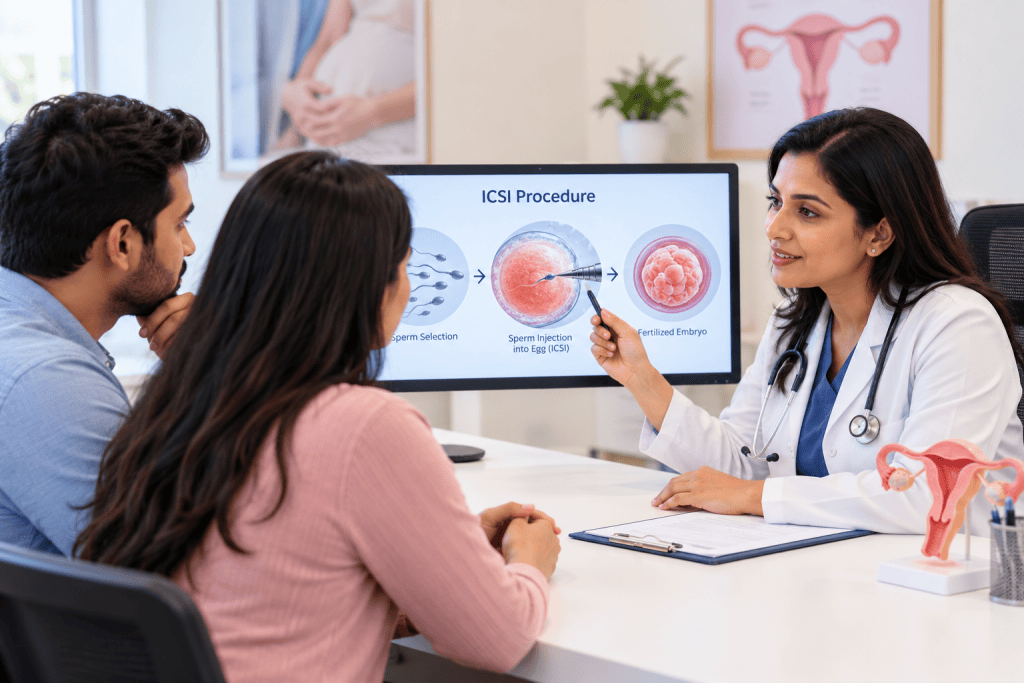
If you have been told you may need ICSI treatment in Bangalore, you probably have two questions. What exactly is it, and is it really necessary for you? Both deserve a clear answer.
The short version: ICSI (intracytoplasmic sperm injection) is a laboratory step inside an IVF cycle in which a single sperm is injected directly into each mature egg. It is needed when sperm cannot fertilise an egg on their own, most often because of severe male infertility. It is not needed, and does not help, for most couples whose sperm is normal.
This guide explains the ICSI procedure, the situations where it makes a real difference, the situations where it is used far more than the evidence supports, and how we decide at Kalpa Clinic.
ICSI and conventional IVF: the difference is in the dish
Every IVF cycle follows the same outline. The ovaries are stimulated with hormone injections, eggs are collected under anaesthesia, they are fertilised in the laboratory, and one embryo is transferred into the uterus a few days later. What varies is the fertilisation step.
In conventional IVF insemination, each egg is placed in a drop of culture medium with many thousands of prepared, motile sperm. The sperm have to swim to the egg, bind to its outer shell and get through it. Fertilisation happens roughly the way it would in the body, only in a dish.
In ICSI, an embryologist holds a single mature egg steady with a fine glass pipette, picks up one sperm in an even finer needle, and injects it through the shell into the egg itself. The sperm does not have to swim, bind or penetrate anything. Everything after that point, embryo culture, transfer and the two-week wait, is identical.
ICSI is therefore not a separate treatment. It is one option for one step of assisted reproductive technology, and the decision to use it should rest on a specific reason.
Who needs ICSI: the clear indications
Severe male factor infertility
This is the reason ICSI was invented in the early 1990s. When sperm count is very low, movement is very poor, or the great majority of sperm are abnormally shaped, conventional insemination often fails because too few capable sperm reach the egg. ICSI bypasses that problem entirely. A single living sperm is enough. For men with severe male factor, ICSI turned a situation that once required donor sperm into one that usually allows a couple to use their own.
Surgically retrieved sperm
Some men have no sperm in the ejaculate at all (azoospermia). In many of them sperm are still being produced in the testes and can be collected through a minor procedure such as PESA, TESA or TESE. These sperm are few, often immobile and immature, and cannot fertilise an egg in a dish on their own. ICSI is the only way to use them. The same applies to men with a blocked or absent vas deferens, or after a vasectomy that cannot be reversed.
Previous fertilisation failure
If a couple has had an IVF cycle in which none, or almost none, of the eggs fertilised with conventional insemination, ICSI is recommended for the next cycle. Total fertilisation failure is uncommon but it happens even with normal-looking semen, and ICSI removes the guesswork.
Frozen eggs and a few other situations
Eggs that have been vitrified (frozen) undergo hardening of their outer shell, so ICSI is standard when frozen eggs are thawed and fertilised. ICSI is also used when embryos will have genetic testing, so that stray sperm stuck to the shell do not contaminate the result, and in rare conditions such as anti-sperm antibodies or sperm that lack the structure needed to activate an egg.
Who does not need ICSI
Here is the part that is not said often enough. ICSI is now used in the majority of IVF cycles worldwide, including a large share where sperm is entirely normal. The evidence does not support this.
Several well-designed trials, including a large randomised trial published in 2021, compared ICSI with conventional insemination in couples without male factor infertility. Live birth rates were no different. ICSI did not rescue poor egg quality, did not help older women, did not improve results in unexplained infertility, and did not improve outcomes when the egg number was low. Professional bodies in Europe and the United States have both stated that routine ICSI for non-male-factor infertility is not justified.
So if your semen analysis is normal and there is no history of fertilisation failure, ICSI adds cost and a small amount of risk without adding chance. A clinic that recommends it for everyone is making a laboratory habit, not a clinical decision.
The risks worth knowing
ICSI is safe in skilled hands, but it is not free of consequences. A small proportion of eggs are damaged by the injection itself and do not survive. The natural selection that happens when a sperm has to reach and penetrate an egg is bypassed, which is why embryologists choose sperm carefully under high magnification.
Children conceived through ICSI have a slightly higher rate of certain birth defects and rare genetic conditions than children conceived naturally. Most of that difference appears to come from the underlying male infertility rather than the technique, but it is one more reason not to use ICSI when it is not needed. Where the cause of severe male factor may be genetic, testing the man before treatment lets a couple make an informed choice.
How Kalpa Clinic decides
Diagnosis comes before treatment. At Kalpa Clinic both partners are evaluated from the first visit, and the semen analysis carries as much weight as the woman’s scan and blood tests. Male factor is half of infertility and it is never an afterthought.
For many men with a mildly abnormal report, the right next step is not ICSI at all. Treating an infection, correcting a hormonal problem, stopping smoking, losing weight and repeating the test after three months can change the picture. Mild male factor is often treated with IUI, where prepared sperm are placed in the uterus at the right time. Most couples who consult us are treated without IVF.
ICSI enters the conversation when the semen picture is severe, when sperm must be retrieved surgically, or when there is a history of fertilisation failure. Dr. Chaitra Nayak, MBBS, MD, FNB (Reproductive Medicine), performs egg retrieval and embryo transfer herself at top registered IVF centres in Bangalore, and the decision to use ICSI or conventional insemination is made with you, on the basis of your reports, before the cycle begins. You will be told why, in plain words, and you are free to ask anything.
Frequently Asked Questions
Is ICSI painful for the woman?
No more than a standard IVF cycle. ICSI happens in the laboratory after the eggs are collected. The egg collection itself is done under anaesthesia, and the injections, scans and transfer are the same whether ICSI or conventional insemination is used.
Can ICSI be done with a normal semen analysis?
It can, but for most couples with normal sperm it does not improve the chance of a baby. Good-quality trials show no difference in live birth rates, so ICSI is reserved for specific reasons rather than used routinely.
Does ICSI guarantee fertilisation?
No. ICSI raises the chance that each mature egg fertilises, but some eggs will still fail, and a few may not survive the injection. It also cannot improve the quality of the egg or the embryo that results.
What if there are no sperm in the semen at all?
Sperm can often be retrieved directly from the testis or epididymis through a minor procedure. Those sperm are then used with ICSI. A specialist will first check hormones and, where relevant, genetic tests to guide the plan.
Is ICSI used for every IVF cycle at Kalpa Clinic?
No. ICSI is recommended only when there is a clear indication such as severe male factor, surgically retrieved sperm, previous fertilisation failure or frozen eggs. Otherwise conventional insemination is used.
Not sure whether ICSI is right for you?
Bring both your reports, especially the semen analysis, to Kalpa Clinic in JP Nagar, Bengaluru, or book a video consultation if you are further away. Dr. Chaitra Nayak will go through the results with both of you, explain what they mean and tell you plainly whether ICSI, conventional IVF, IUI or a simpler treatment is the right next step. Nothing is decided without you. Weekday appointments run from 11:00 AM to 7:30 PM, and Sunday mornings by appointment.
Leave a reply




Leave a reply